Marketing work is now cheap, but coordination is still expensive
At Eldur Studio, we’re trying to prove that one person can run the entire marketing function — if the system does the coordination.
Writing a blog post is cheaper than ever. What’s still expensive is the glue work: briefs, edits, publishing, distribution, reporting, and keeping the backlog honest.
AI reduces the cost of producing the work. It doesn’t automatically reduce the cost of running the work.
The solution: a pyramid, not one all-purpose agent
I talk to people about “one person marketing team” and they have in mind this “one super-agent that does everything.”
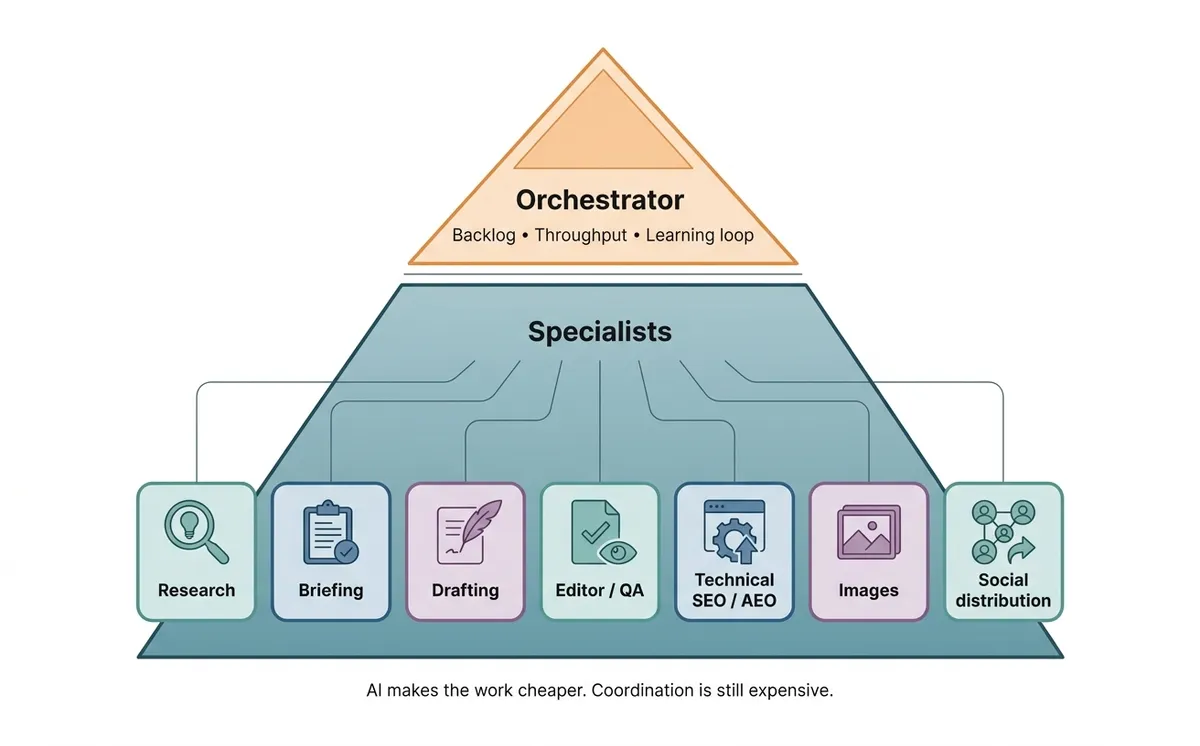
It’s not one - it’s a pyramid:
- Orchestrator (top): decides what gets shipped next and routes work
- Specialists (base): each does one narrow thing well
The core roles in the pyramid - Blog content example
- Research agent: connects to SEO API, finds keywords/topics and competitive angles
- Briefing agent: turns a topic into a tight outline and calendarization tailored to content pillars
- Drafting agent: writes the first pass in your voice and structure
- Editor / QA agent: removes fluff, flags risky claims, enforces style
- Technical SEO/AEO agent: internal links, metadata, schema notes, on-page checks
- Image agent: creates 1–2 image concepts and prompts
- Social Distribution agent: repurposes into LinkedIn/email snippets
You can start with 3 roles and add the rest as needed.
If the premise here — one person, many agents — is new, From No-Code to AI-First Operators is the thesis behind it, and How AI Agents Are Changing B2B Marketing covers what it changes day to day.
The orchestrator’s job (and why it matters)
The orchestrator is responsible for three things:
- Backlog: what we’re writing next and why
- Throughput: what shipped this week
- Learning loop: what we learned and what we’ll change
Without this layer, you end up with a great one-off but a lot of agent babysitting. The orchestrator is not you. It’s another agent running a more powerful model that manages memory and context for everyone else.
This is not programmatic SEO. Eldur Studio isn’t trying to spin up 500 templated pages and call it a strategy.
This is an editorial system with measurable throughput:
- A real backlog with priorities and owners (even if the “owners” are agents)
- Clear quality gates (brief → draft → QA → publish)
- Distribution that’s part of the workflow, not an afterthought
- A weekly learning loop so you get better, not merely busier
How this runs weekly (example)
- Monday: research → choose 3 topics
- Tuesday: briefs + outlines
- Wednesday: drafts
- Thursday: QA + metadata + internal links
- Friday: publish + distribution + weekly report
Where these scheduled agents actually run — inside Notion or on an external runner — is its own decision: Notion AI Agents vs. Cowork.
What makes it work:
- narrow agent responsibilities that can be distilled in short skills
- explicit human approval points
- a single backlog with priority
- a weekly scoreboard and learning memory loop (this is what Anthropic calls “dreaming”)
The key is that each step produces artifacts that survive the week.
Who this is for
Right now, implementing a system of agents isn’t simple. If you’re too small, you don’t have the bandwidth to set it up. If you’re too early, you might not have the messaging and brand voice to guide the agents. If you’re too big, you start running into approvals, security constraints, and tooling complexity.
But if you have a blog, a clear ICP, and a willingness to run a two-week experiment, you can build the first version of this pyramid.
Ship three posts, measure what hit, and then decide where to automate next.
If you want Eldur Studio to implement this with you, the next step is a short working session to map your current content workflow and pick the first three agent roles to ship.