Most B2B teams are feeling the same pressure right now: everything is getting easier to do, but harder to do well. AI can write the ad, draft the landing page, ship the code, and generate ten campaign ideas before your first coffee, and yet most marketing orgs are not getting meaningfully faster. Pipeline still feels random. Reporting still does not answer the real questions. Teams ship a lot of activity without clear leverage, and the whole thing feels slightly overwhelmed by the AI magic rather than empowered by it.
This is not a tooling upgrade. This is a market shift, and I think most of the industry is misreading it.
I want to name what changed, what did not, and what I think a better operating model looks like. This is also the thesis behind what we are building at Eldur Studio this year.
What changed: speed is no longer the differentiator
When we started Eldur Studio, “no-code” was the exciting promise. You could build real software without slow, expensive engineering cycles, and visual development tools made it possible for small teams to ship things that previously required a full dev org. It felt like a superpower.
Five years later, no-code won, but the benefit became background. Large language models pushed this even further, and now “build without devs” is not a differentiator at all. It is the default expectation. The market takes speed and convenience for granted, and the durable edge has moved up the stack.
The advantage now belongs to teams (and individuals) who bring:
- Judgment about what to build, what to say, and what to prioritize.
- Translation between strategy and real execution across brand, growth, and revenue systems.
- Measurement that tells you what is working, why, and what to do next.
Why marketing orgs break in an AI-first world
Marketing specialization made sense when tools were complicated, channels were siloed, and teams could afford the handoffs. That era is ending, and the cracks are showing in a few specific places.
1) Specialization created fragmentation
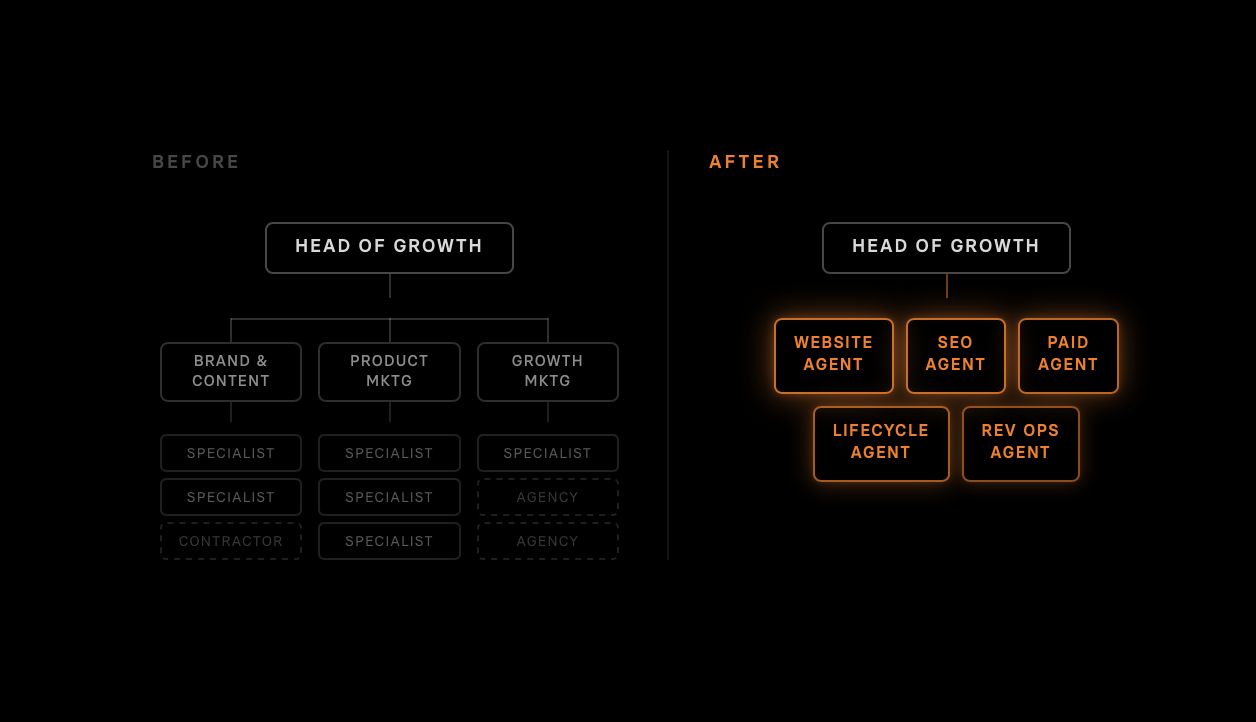
Most teams do not need a roster of narrow experts who each own a tiny slice of the funnel. What they need is an operator who can connect positioning to execution, move across channels, and go deep enough technically to ship durable systems rather than decks and plans. I am not the only one thinking this is a massive organizational shift for marketing (see Emily Kramer’s take on this), but the implication is real: the org chart that made sense five years ago is now a bottleneck.
2) AI raises the bar for what “good” looks like
AI makes output easy, but it does not make outcomes automatic. If anything, it increases the need for someone who can set clear direction, supervise the machines, correct them with real domain knowledge, and build feedback loops that compound over time. One skilled AI-first operator, or a tight team, can now produce at the level of a full marketing department. But that only works if the work is organized around systems rather than tasks.
3) Agency economics do not map to this reality
Ad platforms are increasingly self-serve and performant, and managing a meaningful budget should not require an entire agency layer on top. Even when AI makes execution faster, agencies rarely get proportionally cheaper, because the real cost is not the work itself. It is the overhead: onboarding, meetings, project management, reviews, and the endless cycles required to “prove value.” That dynamic creates a perverse incentive to preserve complexity.
Meanwhile, everyone wants “AI,” but few teams can point to what actually changed in outcomes. So AI becomes a shiny object rather than a measurable operating upgrade.
4) The fractional CMO pattern breaks in the same place
The standard CMO and fractional CMO setup often fails at the same point: accountability and execution. Strategy gets separated from implementation, iteration slows down, and outcomes become impossible to own. You cannot have a good strategy if you do not understand the business deeply enough to execute it, and if you want AI to run your strategy, you will first need to teach it your business.

New org chart, human + agents
Companies do not need more vendors, and they definitely do not need more AI tools. What they need is an embedded, accountable operator who can turn AI into execution systems that actually move revenue.
What did not change: durable systems still matter
We have been building apps and automations for clients for five years. Before LLMs, those systems were not “AI” in any trendy sense. They were business logic plus automation tools like Zapier and Make, and those tools are still thriving, in many ways 10× more powerful than they were when we started.
The lesson from five years of shipping real systems is straightforward: generating output is not the hard part. Scaling, measuring, and improving that output is. We also learned to spot the difference between tools that look fast in demos and tools that can actually handle complexity, traffic, and maintenance in production.
A lot of agentic AI today has the same pitfalls that plagued the no-code wave: it works beautifully for prototypes, breaks under real-world edge cases, and becomes hard to debug and maintain at scale. There is a lot of noise in this space, and knowing how to parse the signal is the actual advantage.
The new model: the Eldur Studio approach
Traditional CMOs often do not get their hands dirty. Agencies often do not understand your business. We think there is a better model, and it starts with embedding directly with your team: auditing your funnel and measurement, recommending a strategy you can actually execute, and then building the AI-powered workflows and agents that turn that strategy into consistent, repeatable output.
The goal is not “more content” or “more campaigns.” The goal is a marketing and revenue operating system that is fast, measurable, maintainable, and ultimately owned by your team.
Pricing philosophy (and why retainers feel outdated)
Unreasonable retainers, paying for effort instead of outcomes, are dying. It does not make sense to pay $5,000–$10,000 per month, or a percentage of your marketing spend, for work that is increasingly automated.
Our model is built around a predictable monthly licensing fee for the systems we deploy, plus milestone-based performance incentives when measurement is clean and outcomes are clear. If we build an agent that replaces your SEO agency, the value is concrete. If we increase qualified leads by 50%, the impact is measurable.
And when your team can run the system independently, we step away. The assets belong to you. We train your team to operate them.
Sounds interesting?
Who this is for
✅ Great fit if
- You are B2B (or B2B2c). SaaS or services both work.
- You sell to technical buyers or in regulated, high-trust environments where messaging and proof matter.
- You are typically Series A–B, or bootstrapped with roughly $2M+ ARR, or a private company under 100 people.
- You want an embedded partner who can own end-to-end execution, not a strategy deck.
- You value measurable outcomes, and you are willing to do the work to get tracking clean.
- You want systems and assets you can keep and run internally after the engagement.
❌ Not a fit (for now)
- Pre-PMF teams still searching for the core product and audience (unless it is a tightly scoped validation sprint).
- Compliance-heavy work that requires specialized regulatory marketing.
- Teams looking for brand-only creative work without a measurable growth objective.
- Teams that want executive advice only and do not want to change how the work gets done.
What we typically do (so you can self-select)
- Diagnose what is broken across website, funnel, channels, and measurement.
- Fix fundamentals like tracking, attribution, lifecycle stages, dashboards, and reporting rhythm.
- Ship growth changes that improve conversion and demand.
- Build repeatable workflows using automation and agents, so output does not depend on heroic effort.
- Teach your team to run it with documentation and training.
If this resonates, reach out!
We onboard a limited number of pilots each quarter. Share your context, your goals, and what is currently broken in the funnel. We will tell you quickly if it is a fit.