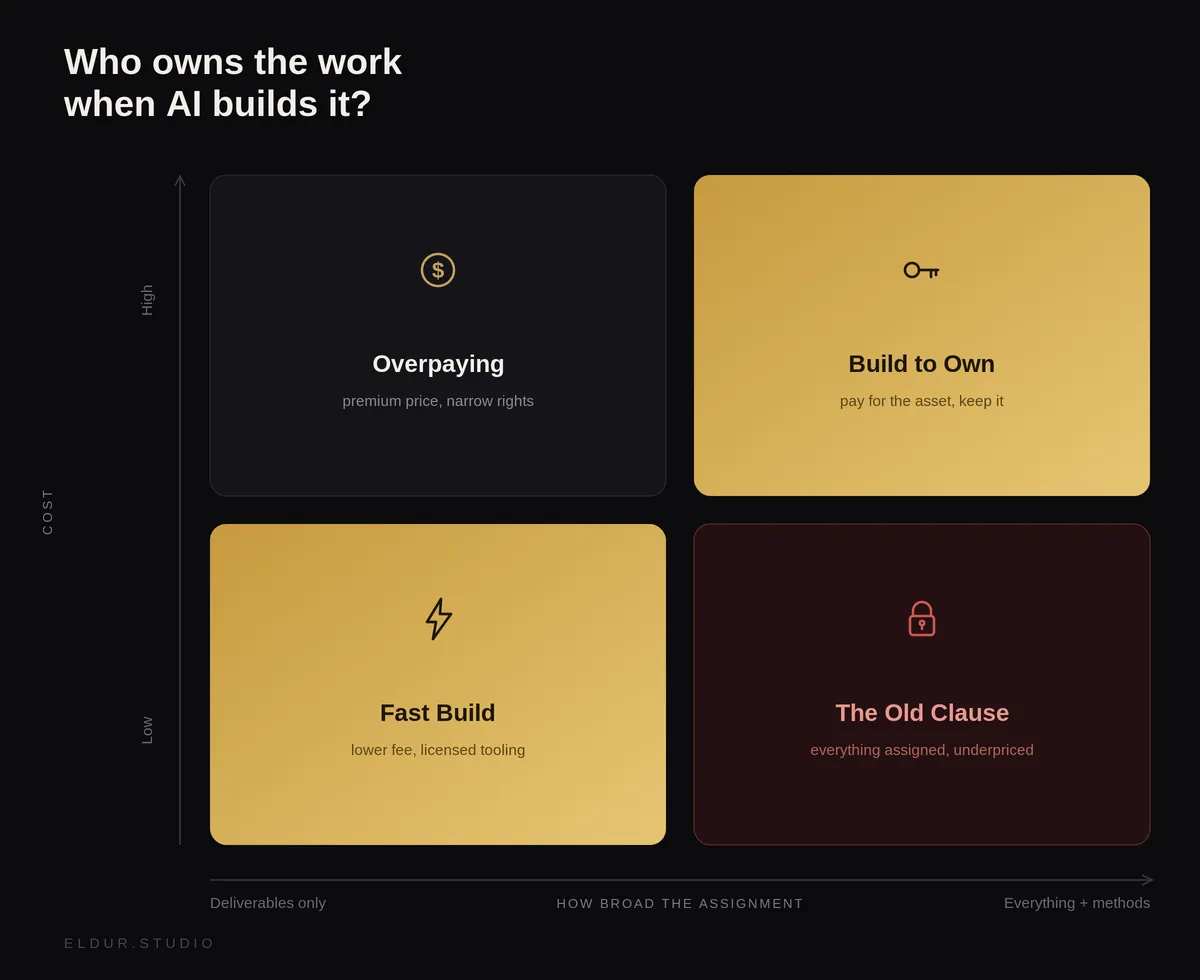
Who owns AI-generated code? Less than your contract assumes.
You hire someone to build your site. You pay the invoice. The contract says “all work is original and assigned to you.” You own it, right?
Maybe not. I’ve reused the same (super-industry-standard) IP clause for years, and this year it stopped matching reality. The build was fast and affordable because the developer leaned on AI agents, reusable skills, and a Model Context Protocol (MCP) setup that wrote most of the code. A clause that assumes a human typed every line, and can therefore sign it all over, no longer describes how the work gets made.
Two things changed under the contract
Ownership got fuzzy. US copyright needs a human author. Code a model writes with little human input isn’t clearly owned by anyone, so “we assign all IP to you” can be handing over rights that don’t exist.
The value moved. When AI compresses a month of work into a week, the code isn’t the asset anymore, the method is. The prompts, the skills, the MCP setup, that’s what makes the speed possible, and it’s what a good builder reuses on every other client. “Assign everything” stops being harmless boilerplate and starts asking someone to give up their livelihood.
The fix: three buckets, not one
The confusion clears the moment you stop treating “the work” as a single thing.
- Deliverables are yours. The site, the component library, the designs, the docs, assigned on full payment. This was always the point.
- The tooling stays with the builder. Their automation and MCP config are the factory, not the product. You don’t need the factory, but you should get a license to whatever’s baked into your deliverables so you can use them without worry.
- Methods built during the project are the real decision. They can be assigned to you or licensed to you. Pick one on purpose, in writing. Silence here is where disputes live.
Two lines that now belong in any dev contract: a date boundary on “pre-existing IP” so it can’t quietly absorb what’s built on your project, and a warranty that any AI or third-party tools don’t drag restrictive licenses into your codebase.
How we handle it at Eldur Studio
We make the choice explicit up front and price it honestly. Two ways to work:
- Build it fast with our methods. You get the finished product quickly and affordably. We keep the methods and tooling that made it fast and reuse them, the way any studio reuses its craft.
- Build the methods for you to keep. We develop the system and hand you ownership, so your team or your next developer can build on it. That’s more work, so it costs more.
Neither is the right answer by default. It depends on whether you’re buying a website or an asset. The trap is paying for one and assuming you got the other, which is exactly what an old work-made-for-hire clause lets happen.
Not sure which one you need? That’s the conversation worth having first. Take a look at the 2x2 matrix before to help you decide
FAQ
Does my developer own the code an AI agent writes for my project?
No, and that’s actually good news for you. If an AI agent generated the code with little human authorship, no one has a clean copyright claim on it, including your developer. What you get from your developer is the deliverable, assigned to you on payment, plus whatever human-written glue code and configuration they added on top. The uncertainty is a reason to get the license language right, not a reason to worry someone else secretly owns your site.
Is AI-generated code protected by copyright in the US?
This is a new topic, changing fast. At the moment, in the U.S. it doesn’t. US copyright needs human authorship, so code produced by a model with little human input may not be protected, which means it can’t be cleanly assigned either. Human review and editing strengthen the claim, but one must prove the uniqueness of the code and the inability of a model to replicate it.
What happens if my contract says “all work is original” but AI wrote most of the code?
That clause is doing less than it looks like. “Original and assigned to you” assumes a human authored the work and can sign the rights over, but if AI wrote it with minimal human input, there may be no exclusive rights to assign in the first place. It’s not fraud, it’s boilerplate that hasn’t caught up. Ask your developer directly which of the three buckets, deliverable, tooling, or methods, the AI-generated pieces fall into, and get that in writing instead of relying on old IP language.
Is AI-written code considered work made for hire?
Not cleanly, no. Work-made-for-hire doctrine assumes a human employee or contractor is the author, and copyright law currently requires human authorship to begin with. If AI generated the code, there may be no authorship to attach a work-made-for-hire label to, which is exactly why an old “we assign all IP to you” clause can promise more than it can deliver.
Should I own my developer’s tooling, especially if it’s custom for my project?
Usually not, and you don’t need to. Historically, dev tooling has been. You want the deliverable plus a license to any tooling baked into it. The automation and prompts are how a good builder stays fast, for you and for their next client.
Should I assign the methods built during my project, or license them?
Assign if you plan to build a product on them or want an asset that outlives any one developer. License if you just need to use and extend your own site. Either way, decide it in writing.
The compliance version of this problem — what happens when agents touch regulated data — is in Building HIPAA-compliant AI agents.
While I hold a Law degree and LLM, I’m not a practicing attorney. This is a practitioner’s take, not legal advice. For anything you’re signing, ask a local licensed lawyer.
— Veronica