Last updated: June 3, 2026
The shift is already happening
B2B buyers do most of their research before ever talking to a sales rep, B2B marketing’s main job is to get your product in the consideration set, build trust, help compare, and convince customers your solution is just right for them, and you need them now. AI agents are actually really good at this.
What an AI agent actually does
Strip away the hype and an AI agent is a system that:
- Monitors something (a signal, a trigger, a schedule)
- Reasons about what to do next
- Takes an action — writes a draft, sends a message, updates a CRM, fires a Slack notification
The difference from a basic automation: agents handle ambiguity. They go beyond if/then rules and make judgment calls.
Underneath, every one of them is the same three parts — a brain, memory, and tools. The Core Anatomy of an AI Agent breaks that down.
Three places agents are replacing manual work right now
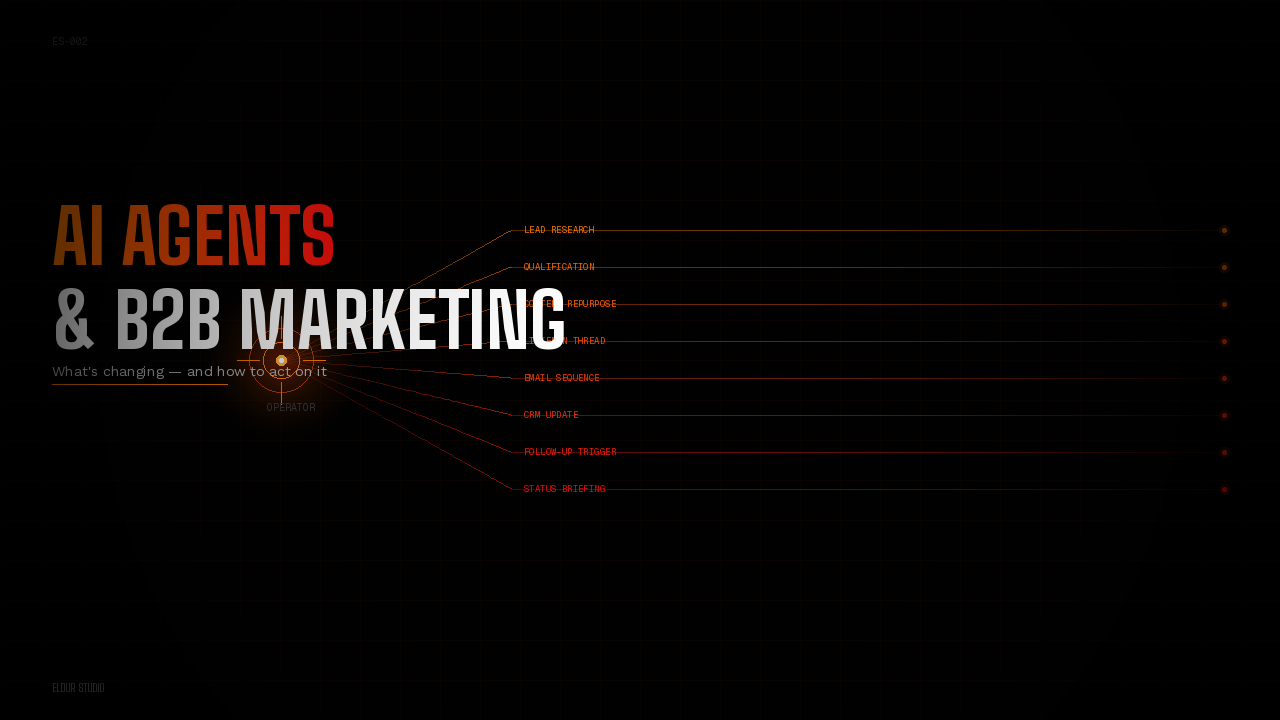
Lead research and qualification. Instead of a rep spending 20 minutes researching a company before a call, an agent does it in 30 seconds: pulls LinkedIn data, recent news, tech stack signals, and writes a briefing doc. We get hire quite often to help companies set up an agent in the platform of their choice; see we enriched 400+ VC contacts in 2.2 hours using Explorium + Notion + Pipedream, with a 95% match rate for major firms.
Content repurposing. You publish a long-form post. An agent converts it into a LinkedIn thread, a short email, and a summary card — while you’re doing something else. We have a wonderful Notion Agent that does that (template coming soon!)
Technical SEO. An agent crawls your site on a schedule and catches the issues that quietly erode rankings — broken links, missing meta descriptions, orphaned pages, slow-loading templates, gaps in your schema markup. Instead of a 200-row audit export no one opens, you get a short, prioritized fix list, with the routine fixes handled for you.
What this means for marketing teams
Agents replace tasks, not people. But you can run a large number of them in parallel, and the math works in your favor. A solo operator with three well-designed agents can match the output of a team of five — on the work that agents are good at. The Multi-Agent Marketing Pyramid is how those agents fit together without turning into chaos.
The trap is trying to automate everything at once. Start with one high-value, high-repetition workflow. Get it working. Then expand.
The best AI agent is the one that runs quietly in the background and surfaces only when something actually needs your attention.
Start with one workflow
Map your last five workdays. Find the task you did most often that required the least judgment. That’s your first agent.
If you’re not sure where to start, book a call and I’ll scope it with you in 30 minutes.